integration4 min read
What Boomi Is Good At—and What Still Requires Engineering Judgment
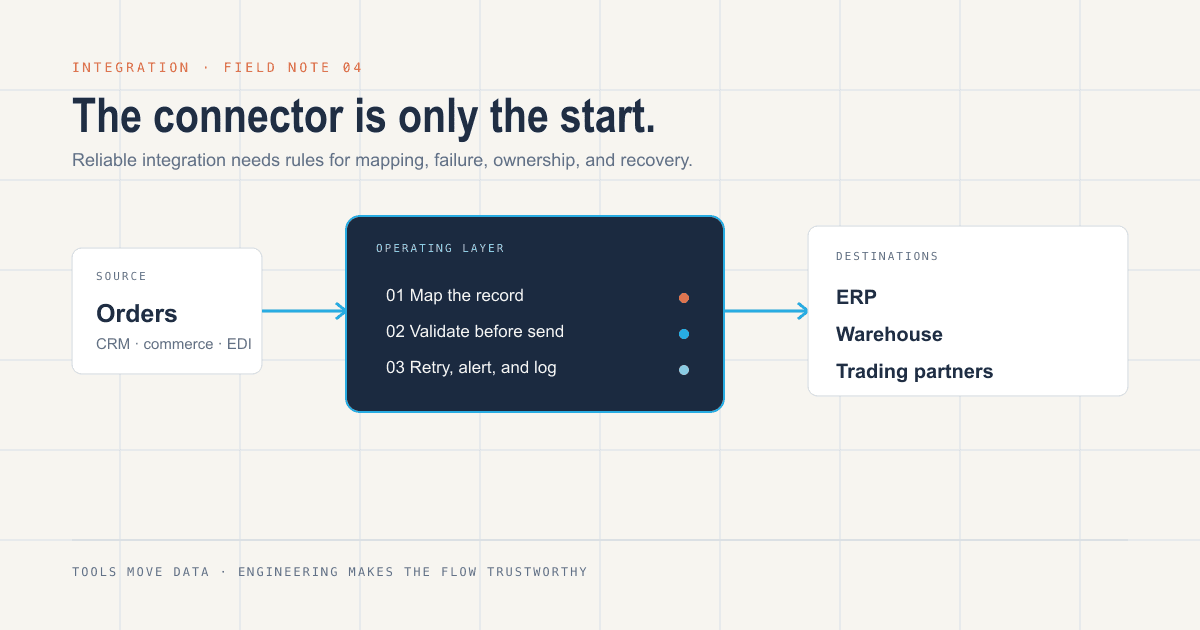
Boomi can shorten the distance between business systems. The hard part is still deciding what the data means, who owns the workflow, and what happens when a transaction fails.
This article was originally published when HiTek joined the Boomi Partner Program in 2024. It was substantially updated in July 2026 to explain the engineering work behind a reliable integration.
Boomi is useful when a business has important systems that need to exchange data without people copying it by hand. It gives an integration team connectors, mapping tools, deployment controls, monitoring, and a shared place to operate the flow.
That can save a lot of time. It does not remove the need for technical judgment.
The connector is usually the easy part. The real work is deciding what a record means in each system, which source wins when the data disagrees, and how the business should recover when something fails halfway through.
Where Boomi earns its place
Boomi tends to fit when the integration is important enough to operate—not merely script once and forget.
Examples include:
- keeping customer and order records aligned across a CRM, ERP, and ecommerce platform
- translating EDI transactions between trading partners and internal systems
- moving product, inventory, shipment, or invoice data on a schedule
- exposing a governed API in front of a legacy application
- replacing a collection of one-off scripts with a flow the team can monitor
The value is not “low code” by itself. The value is a common operating layer for integrations that need ownership, visibility, and repeatable deployment.
What the platform cannot decide for you
A reliable integration still needs answers to practical questions:
- Which system owns each field? The CRM might own the sales contact while the ERP owns the bill-to record. “Synchronize both ways” is not a data strategy.
- What counts as a valid transaction? Required fields, identifiers, units, dates, and category rules need to be checked before bad data reaches the next system.
- What happens after a partial failure? If the order was created but the acknowledgment failed, can the flow retry safely without creating a duplicate?
- Who gets alerted? An error queue nobody owns is only a quieter version of manual work.
- How will the team investigate later? Logs need enough business context to answer what happened without exposing sensitive data.
Those decisions matter more than how quickly someone can drag a connector onto a canvas.
A small example
Say an ecommerce order needs to reach an ERP and a warehouse system.
A fragile flow maps the fields and sends the record.
A production flow also:
- normalizes the customer and product identifiers
- verifies the destination recognizes every item
- assigns an idempotency key so a retry cannot create a second order
- records the source order number in every downstream transaction
- distinguishes a temporary outage from a data problem
- retries only the failures that are safe to retry
- alerts the right owner with enough context to act
Boomi can implement and operate that flow well. The quality still comes from the rules around it.
When Boomi may be more than you need
Not every integration needs an iPaaS. A direct API connection or a small scheduled service can be the better answer when the flow is narrow, the systems are stable, and the team can support the code.
The decision should account for:
- the number of systems and trading partners
- transaction volume and business risk
- monitoring and support expectations
- the team that will own the integration
- licensing cost compared with custom development and maintenance
- how often mappings or partner requirements change
I would rather recommend a smaller solution that the team can operate than force a platform into a problem because we happen to know the platform.
The practical takeaway
Boomi is a capable integration platform. It works best when the team treats integration as an operating responsibility, not a drawing of arrows between applications.
Start by naming the source of truth, the validation rules, the failure paths, and the owner. Then choose the tool that makes those decisions easier to run in production.
Related
- Enterprise Integration — how HiTek approaches APIs, EDI, data flow, and operational ownership.
- Selected work — systems and integrations we have built and operated.
- How we work — understand the workflow, explain the tradeoffs, then build.